
Introduction
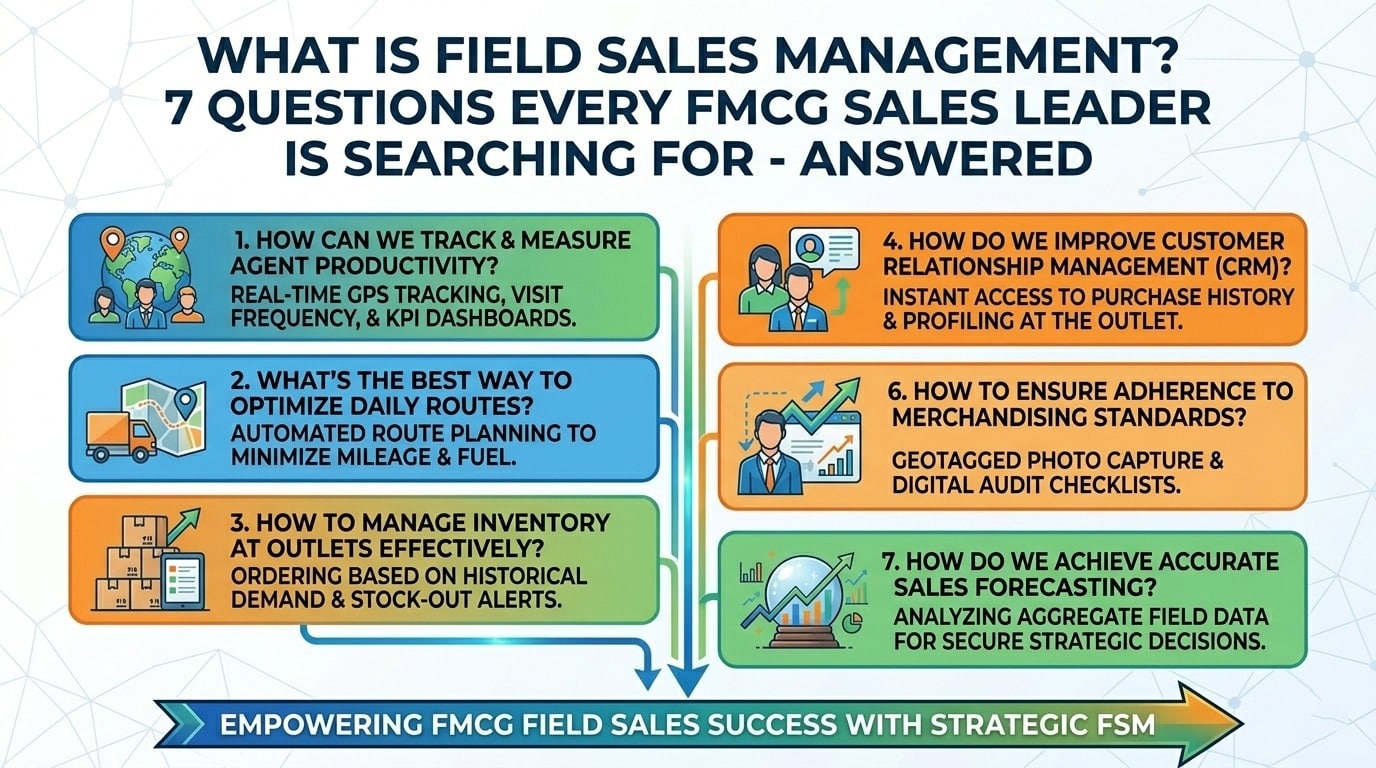
If you manage a field sales team and you can’t tell me right now — without calling anyone — how many outlets your reps visited today, how many orders were booked, and which rep is behind target — you have a field sales management problem. And it’s costing you more than you think. Most FMCG leaders operate with limited visibility, delayed reporting, and manual tracking. This blog answers the 7 most important questions FMCG sales leaders are asking: revenue loss, tracking reps, productivity improvement, software selection, and ROI.
What Is Field Sales Management and Why Does It Matter for FMCG
Field sales management in FMCG is the system of planning, executing, tracking, and optimizing everything your sales reps do in the field — routes, outlet visits, order booking, collections, POSM placement, and reporting. Unlike other industries, FMCG field sales involves hundreds of outlets, high SKU counts, and daily beat execution. A single missed outlet can affect distribution coverage and shelf visibility. Without structured field sales management, companies struggle with inconsistent coverage and lost opportunities. In FMCG, your field team is your brand. What they do — or don’t do — at each outlet directly determines your revenue.
How Are FMCG Companies Losing Revenue Due to Poor Field Sales Management
Research across FMCG field operations shows that companies without structured field sales management lose between 20–30% of potential revenue per quarter — not to competitors, but to their own operational gaps. Unoptimized routes mean reps visit 40–50% fewer outlets than possible per day. Manual order-taking leads to 5–8% order error rates, translating to ₹10–16 lakh monthly loss for a ₹2 crore operation. No real-time visibility means managers react to 24–48 hour old data, missing promotional windows worth ₹5–10 lakh per cycle. Without GPS tracking for sales team activity, 15–20% of field hours remain unaccounted for due to ghost visits and attendance gaps. Manual reporting consumes 90–120 minutes per rep daily, reducing selling time. None of these losses show up as a single line item. They bleed quietly across every month’s P&L.
How Can You Track Field Sales Reps Without Micromanaging Them
FMCG managers want visibility without constant phone calls. The goal of tracking is accountability, not surveillance. GPS-based attendance, geo-tagged visit verification, and automated check-ins eliminate manual follow-ups. With real-time field tracking, managers see live location, completed visits, and order value instantly. Companies using real-time field sales tracking report 22% improvement in visit completion rates and 18% reduction in non-productive field hours within 60 days. Proxima SFA’s Command Center dashboard provides instant visibility across teams, reducing dependence on calls and WhatsApp updates. When managers stop chasing updates, they start managing performance.
What Features Should a Field Sales Management Software Have for FMCG
A field sales management software built for FMCG must handle AI-powered route planning that reduces travel cost by up to 25%, GPS-based attendance and live tracking, geo-tagged visit verification, and mobile order booking with real-time stock visibility through order management. It must support dynamic trade schemes and pricing so reps never apply incorrect discounts, enable offline functionality for Tier 2 markets, and automate reporting to eliminate manual paperwork. The platform should also support AI-powered route planning, van sales automation, distributor management, retail execution, and trade schemes. If the software you’re evaluating doesn’t handle all of these without requiring your IT team, it was not built for FMCG.
Want to see how this works in your field team Request a Free Demo
How Does Field Sales Management Software Improve Sales Productivity
Before automation, reps spend 90 minutes daily on paperwork, follow inefficient routes, and miss high-potential outlets. Managers rely on manual updates and delayed reports. Productivity remains inconsistent across teams.
After implementing field sales management software, Proxima SFA generates optimized beat plans every morning. Reps spend under 15 minutes on admin tasks, managers monitor performance live, and order accuracy improves from 92% to over 99%. When a rep spends less time on paperwork and more time in front of a retailer, revenue goes up. That is the entire value proposition of field sales management software — and the math is straightforward.
Is Field Sales Management Software Suitable for Small and Mid-Size FMCG Companies
Small and mid-size FMCG companies benefit even more from automation because they operate with tighter margins. A 10-rep team losing 2 hours daily equals 20 hours of lost selling time every day. Proxima SFA goes live in under 1 hour, requires no IT infrastructure, and works offline in low-connectivity markets. Pricing remains accessible and scalable as teams grow. Smaller companies often see faster ROI because operational inefficiencies impact them more directly.
How Do You Choose the Right Field Sales Management Software for Your FMCG Business
Start by evaluating whether the software works offline in low-connectivity markets. Next, confirm it supports FMCG-specific workflows such as van sales, distributor management, and trade schemes. Ensure it can go live quickly without IT dependency. Check whether it offers a live dashboard instead of next-day reports. Finally, confirm transparent pricing with no hidden setup costs. If you can answer yes to all five, you’ve found your platform. Proxima SFA was built to clear every one of these requirements — purpose-built for FMCG, not adapted from generic CRM systems.
Conclusion
Every question in this blog has one answer underneath it: the companies that are winning in FMCG field sales are the ones that replaced guesswork with data, manual processes with automation, and phone-call visibility with live dashboards. The companies still asking these questions in 2027 will be the ones asking why their market share went to someone who answered them in 2025.
Request a Free Demo — see Proxima SFA live in 20 minutes.
Start Your Free Trial — live in under 1 hour, no credit card required.